By Katelyn M.
Considering the state of the world today, one cannot deny that politics is making its way into our classrooms. We live in the digital age, where the news gets around much easier and finds its way into all aspects of our lives.
How do we approach this in schools? The purpose of a classroom is to create a learning environment and ensure students have a safe space and feel respected and valued.
Teachers have the job of navigating the classroom and finding ways to represent everyone. While they are teachers, they are also individuals and entitled to their own beliefs, but does their status as teachers prevent them from being able to share it?
In New York City, Chancellor David Banks recently re-enforced a rule in response to the ongoing Israel-Palestine conflict stating that:
“School leaders, teachers, and other school staff should not express their political views about political matters during the school day, while on school grounds, or while working at school events, and they must set aside their personal views during class discussions about current events.”
This statement reignited the debate on how teachers should be able to express their individual beliefs on and off school grounds and welcomed criticism of the Chancellor’s response to political conflicts.
The Conflict At Hand
On October 7th, 2023, the ongoing Israel-Palestine conflict ignited when terrorist group Hamas, the governing group of Palestine, launched an attack against Israel, killing hundreds of Israeli and Palestinian civilians, injuring over two thousand, and taking at least 236 Israelis hostage.
As of October 10th, it was confirmed by the Israel Army Radio that more than 1,000 people had died in Israel, and 900 people had died in Gaza from the Palestinian Ministry of Health.
Email: October 10th, 2023
On October 10th, 2023, at 5:32 PM, Chancellor David Banks emailed all New York City public school teachers, extending his condolences regarding the conflict.
“I write with a heavy heart after this weekend’s terror attacks against Israeli civilians– including children. I unequivocally condemn these horrific acts of violence…”
While it was his duty to make a statement to his employees, it was not representative of the entire conflict. The quote served as the context of the email. It made it clear that Mr. Banks’ sympathy was extended to the “Israeli citizens” and made no mention of Palestine. That was one of the first observations made by some of the teachers who received this email, who will remain anonymous to protect the sanctity of their place in the NYCPS system.
The teachers reported feeling “taken aback” at the email and its contents, in particular worrying that,
“When a government or school official picks a side, people can easily feel underrepresented.”
The Chancellor’s quote shows implicit bias, which refers to when a person does not realize they are biased in their language.
Following the last quote, the email states,
“The brutality and trauma wrought by Hamas upon innocent people– especially our youngest members of society– is devastating.”
The mentioning of Hamas serves an unintended purpose, equating Hamas to Palestine because they are not mentioned. Mr. Banks confirms that the subject is the Israel-Gaza war. If he has already stated that the attacks were against Israel, it can be assumed that the attackers represent Gaza. The only group mentioned other than Israel in the body of the email is Hamas. From one of our sources who noticed this:
“Hamas does not represent the people, the children, the workers, the doctors, or all the people of Palestine. Hamas is the ruling organization of Palestine. They are not the same as the people and civilians who are paying the price of this conflict with their blood.”
Lastly, Mr. Banks goes on to clarify that his priority is ensuring that the NYCPS community feels safe and respected.
Our community can only feel safe if represented by the most extensive powers in our school system. Our sources say,
“There is a group of students I know, especially with these emails, who felt a little forgotten… where they do have family that lives in Palestine or are affected by this conflict, and when they see a public email like this, or when our government keeps a certain stance over another country’s stance, it belittles people.”
In the Middle
Since that email was sent, we have seen massive progression in the war and instances of violence sweeping through Palestine. As of November 8th, 2023, we’ve seen social media videos of the Israeli military pouring cement into the Palestinian water sources, the death toll in Palestine skyrocketing, increases in diseases in Palestinian children, and many more atrocities.
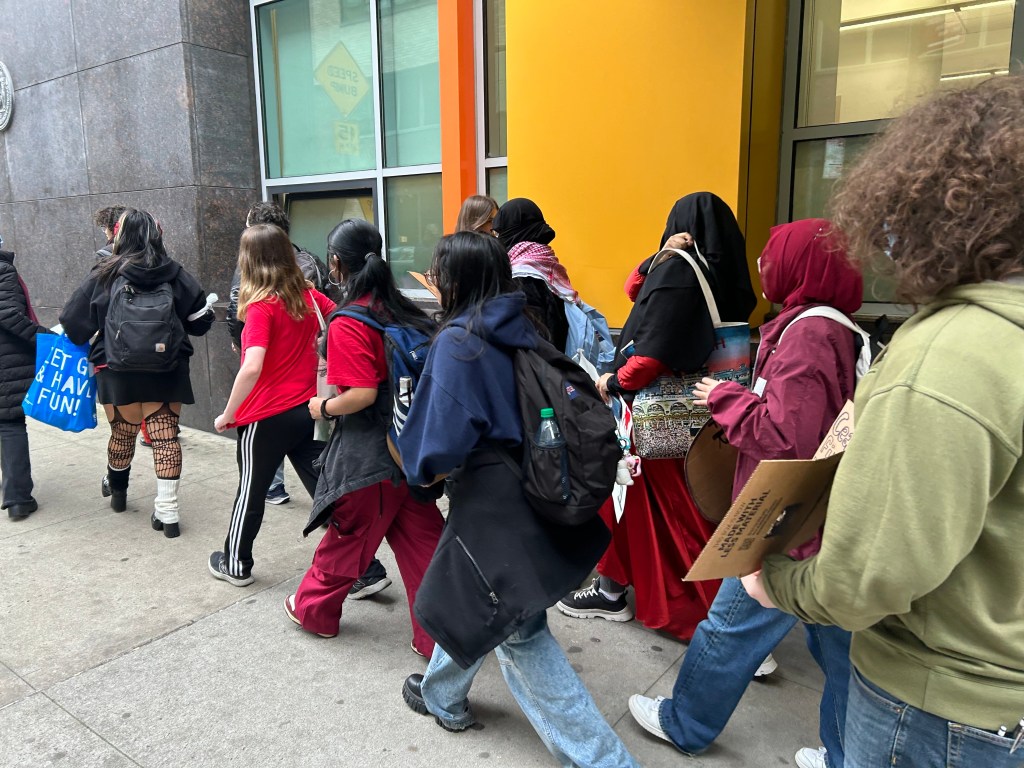
The Free Palestine movement gained incredible popularity, and many groups began organizing public demonstrations to end the United State’s support and funding of Israel. Examples of this include walkouts, precisely one in NYC.
“Students had organized walkouts across all the [NY] cities against the genocide in Gaza.”
This walkout to some seemed like it influenced the second email that Mr. Banks sent out on November 8th, 2023, since it was set to happen the day after:
“I do not think you can separate it from the context. It was the day before a citywide walkout of students. It was a couple of weeks after two teachers had already been dragged into the tabloids, a high school teacher and a pre-k teacher, for being anti-Jewish when, in reality, they were just calling out Israel as a terrorist state and asking parents and students and teachers to not be silent on Palestine.” says our sources.
This email was much more detailed and thorough, but its subject was not about the war but about how teachers should respond.
Following the recent atrocities, it came as a shock to some that Mr. Banks didn’t explicitly extend his condolences to the Palestinian civilians.
“It could’ve been an opportunity, but he clearly missed it.”
A Teacher’s Individuality
So, is this policy just? To answer this question, we first must answer the question: What is a teacher?
“My role is definitely to do my best to make sure students understand the context for this conflict.”
“My role is to provide as many facts as I can and let students form opinions about it.”
“To tell the truth.”
“To have my students come up with their own truths.”
The consensus on the role of a teacher is to provide factual information to allow students to come up with their own conclusions. However, there are differences in the teachers’ opinions on the importance of personal political views alongside that. When asked if their political beliefs are important to share with their students, one source posed a question:
“Does it matter to you if you knew if your teacher was in support of the genocide? Would you feel differently if you knew that your teacher was anti-semitic? Would you feel differently if your teacher was against the George Floyd movement in 2020? It’s pretty absurd for me to teach Black, Latin, Caribbean, and Muslim working-class students and say that I have to stay neutral. It’s impossible.”
While many would see this and say that this is precisely why students shouldn’t know a teacher’s political views, they argue that some issues should be defined to students because of the severity and that a teacher should be able to make clear that they don’t support a certain kind of hate or injustice.
Another account argues:
“Generally, no. I think it’s more important that they don’t. I think it’s more that we, as teachers, try to let them know that it’s okay to have views that differ from people. And sometimes teachers may not recognize the influence of their position, where if they tell students how they feel about political or moral-ethical issues, it might come off as a factual thing instead of an opinion.”
They bring up an important point about the power imbalance between students and teachers, where students see them as role models and might think that what teachers say might be considered fact. The point of teaching is education, not indoctrination.
However, the fact that many teachers may or may not find expressing personal beliefs important does not mean that everyone believes it should still be restricted, especially regarding a teacher’s private life, regardless of whether a student is looking.
“I understand where there is a division between my professional social life, and I totally agree with that. But it jeopardizes my individualism. If I can’t express my own opinion, I can’t access the knowledge that I may not know because I’m not able to actually post or research or do these things that I want to do or maybe gain a perspective from another follower who may disagree or agree with me.”
“I think telling us to not talk about this with our colleagues or within the workplace– that’s an infringement on our rights to free speech.”
Teachers– while they serve a purpose to our youth, they are not machines; they are individuals with thoughts of their own. So, while some may see a need to be objective in the classroom, there’s no reason they should be bound to that on or off school campuses.
A Slippery Slope
The email continues on to reference the DOE’s standards on political speech in schools, which was described as “strategically ambiguous” and “vague” by our sources. They say that,
“Where misinterpretation and miseducation seep in is where there is vagueness.”
One of our sources provides insight on the subject of publicizing political views as a teacher. When given a scenario: If a teacher were to post something political on their social media account, they detailed that:
“I think it’s a very slippery slope. I think depending on the message or the exact nature of the post, it could under certain circumstances be punishable, but it would have to be a clear violation of a rule, policy or social norm because teachers should have the same freedom of speech in their private life that everyone is entitled to. The idea is that what you post on the internet is not private. Once it’s there– it’s there. I can understand why there should be some guidelines, but at the end of the day, every individual should have the right to express themselves in a personal setting.”
They mention that the internet is permanent and one’s digital footprint is incredibly traceable and real.
“I suppose he’s [Chancellor Banks] insinuating that the things you post on social media could alienate certain groups of people and incite them to lose respect for you. I think it’s a hard thing to define. If you remember the Tinker v Des Moines case, the kids went to the Supreme Court, saying that a silent post wouldn’t disrupt the school environment. Still, we live in a different time, where the things that you say online are there forever, so I think more than anything he’s trying to caution people to realize that even when they’re outside of school, words are very powerful.”
Now What?
Words are indeed powerful, and the implications and consequences of the words we choose to use certainly dictate this policy and the overall controversy regarding politics in school. The language we use genuinely speaks volumes.
The topic of politics in schools is indisputably going to continue to be a controversial subject, as that is just the nature of politics in general. With insight from teachers, we’ve discovered that whether this policy is just and whether politics should be discussed at a personal level in school is a complex question. The answer to these questions will not be found in this article. It will, however, be found in those who make up the core, raw structure of the NYC school system.
 The BILA Wave
Leave a comment