
By Keiera Calderón
From the evening of March 29 to March 30, Eid al-Fitr, which literally means ‘festival of breaking the fast’, is an annual Muslim festival celebrated by our BILA Muslim community, marking the end to Ramadan – a month-long period of fasting. Muslims worldwide gather with family and friends to exchange gifts, feast, and partake in a day of renewal and gratitude.
During Ramadan, vital members of our school community who belong to the Muslim faith go on a journey of spiritual reflection. This includes fasting, abstaining from certain activities and willingly sacrificing their meal times during hours of sunlight to grow closer to God and empathize with the less fortunate. Despite these challenges, they continue to show up to school each day, putting their best foot forward. Their dedication and resilience deserve our recognition and respect.
What Transpired
The Student Council put together an event to celebrate Eid with our Muslim-faithed community, which was scheduled on April 10 after school, the Friday before Spring Break. This thoughtfully planned gathering would have inevitably sent the school community off with new connections, deeper understandings and – above all – joy and togetherness.
“I think it’s a great opportunity to bring all students together to share food, make memories, and it’s a moment of joy and recognition for students who mostly go unnoticed. Most of these events were attended by non-Muslim students who came to support,” said Ms. Nahar, ninth grade English teacher and co-advisor of Student Council.
This event was designed to give us a deeper grasp on what Eid means to our Mmuslim peers.

A student celebrating Eid in the 2019 celebration
According to Marionette Augute, member of Student Council, “Eid is practically to represent those who are Muslim, to just educate people on what’s occurring within the Muslim community. Eid actually started in 2019 here in BILA. And ever since then, Eid is meant to be an event to welcome those who are Muslim and show them that you are seen in BILA.”
However, the event was abruptly cancelled due to religious imbalance.

Ms. Nahar and Ms. Bhehaspat at the 2024 Eid celebration
In an email to the Student Council advisors, administration wrote, “In order to be equitable to all of our stakeholders, we will postpone the Eid celebration until we can plan an interfaith celebration. … This can be a learning opportunity for the whole community. Or, we will not have any celebration at all.”
Easter, which takes place on Sunday, April 20th, a religious holiday celebrated by our larger Christian population, falls fairly closely to Spring Break. Administration felt as though that it wasn’t given as much recognition as Eid was being given, and that if one religious event was being celebrated then the other should too. It was a both or none situation.
Many community members felt as though this approach was unwarranted and unfair to our minority Muslim population within a predominantly Christian community. They believed that, as a minority group, Muslim students should be given the opportunity to express their culture and educate others about practices that they may be unfamiliar with.
Reactions to the Cancellation
Some staff and students sensed that their voices and beliefs were being suppressed, fueled by growing anti-Islamic prejudice growing in the political climate, and spoke out against it.
This decision mostly affects our Muslim population and it is their right to be represented as part of our diverse school culture. “I feel very sad because it was supposed to represent my culture and they just cancelled it. I was so excited to go to it. And I’m so disappointed by the admin’s decision,” an eleventh-grade member of our Muslim community, Asarar Suhail, adds.
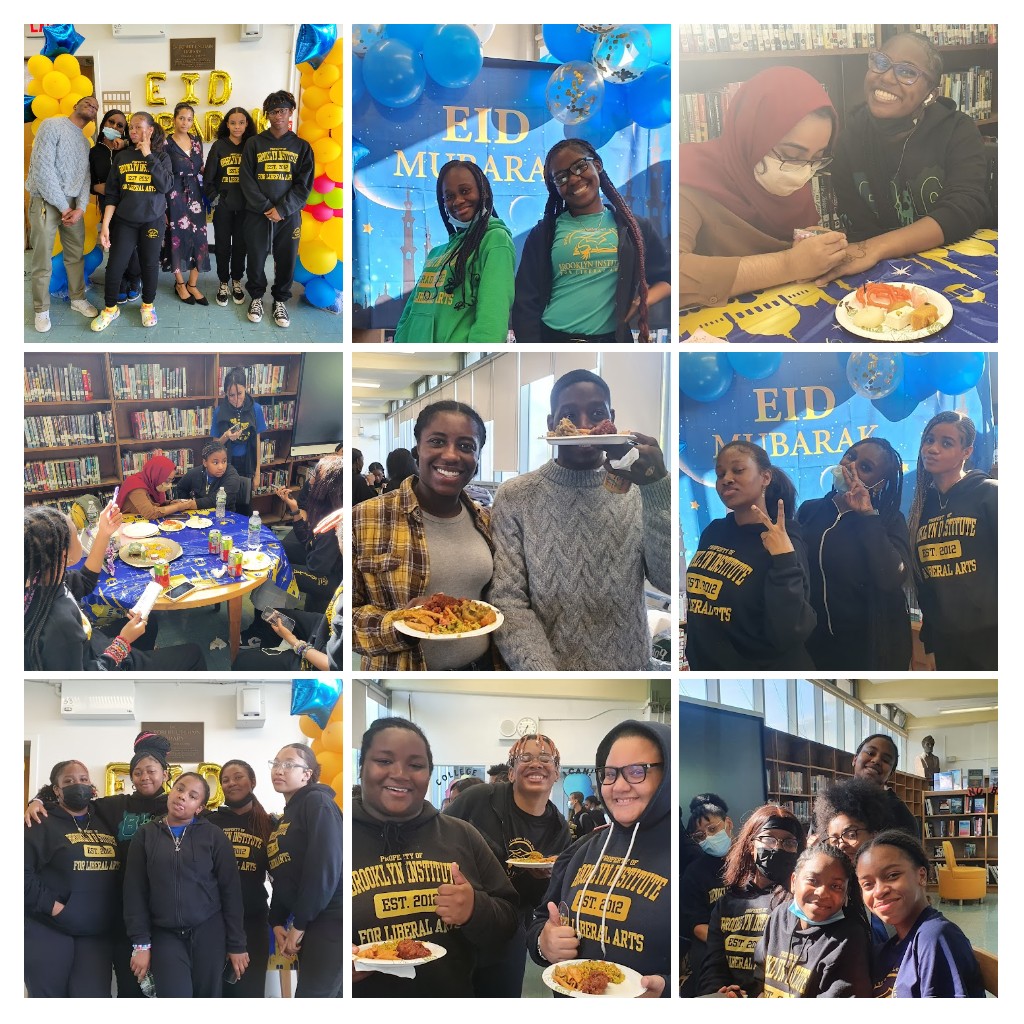
A collage of students and staff celebrating Eid
Mr. Mohamed, who is one of our Muslim mathematics and history teachers, expressed his discontent by saying, “I heard about the change, and it immediately reminded me of the ‘All Lives Matter’ response to Black Lives Matter—a refusal to give marginalized voices space without centering the majority. Postponing the school’s Eid event for Easter feels like a quieter version of that…From what I understand, the Eid celebration has been held for years, so it’s hard not to view this as a reflection of today’s broader political climate where even basic recognition of underrepresented communities is framed as exclusionary.”
“Ms. Ali and I were surprised at this last minute change because it had already been approved. And this is an event that has been anticipated and requested by students every year,” says Ms. Nahar. “This is the first year that it has been pushed back. We have been celebrating it since 2019.”
Kashawn Wright, a tenth-grade student who is not familiar with Eid al-Fitr and is new to BILA from the SHR merge, explained, “I don’t really know what it is since I’m not Muslim but I wish I had the chance to go so I could be educated on it…I wanted to eat with some of my Muslim friends.”
Students like him were meant to be enlightened on the holiday, and to be part of intercultural exchange efforts, but are unable to due to the unexpected circumstances.
“I was really looking forward to doing some henna. That’s so unfortunate,” another student remarked.

2019 Eid celebration
The Student Council was called “narrow minded” for not including the other celebrations as part of the event.
Auguste adds on, “Many people believed that it being postponed just to collaborate it with Easter celebration was not unfair, but … more unneeded.”
“I think that it’s unfair that the decision to have a joint celebration wasn’t brought up before approval was given to do the Eid celebration. I do think it would be better to celebrate all the cultures that are experiencing holidays at the same time with a joint celebration because it could be a nice way for others to learn about other cultures,” said Ms. O’Mealley, a Global History teacher who taught at School for Human Rights last year. “But since the Eid celebration had already been sanctioned, why wasn’t that thought made then? Because we knew that Easter was coming up, we also knew Passover was coming up; all of it could’ve been together so that students and staff could’ve had a larger, more interconnected event and for all of it to be postponed last minute feels like a mean thing to do, in general.”
At the time of printing, The BILA Wave was unable to receive a comment from administration. The article will be updated to reflect any statements from administration on the online version of this article at bilawave.com.
Though Eid’s postponement may have caused great discouragement for many, the silver lining is that students and staff have more time to plan out the event.
 The BILA Wave
Leave a comment